_edited.png)


Dormant trees reveal their stories

I love seeing deciduous trees when they have lost most of their leaves, with bare branches in the winter. So much is revealed now, that was previously hidden by a lush coat of foliage. We can learn to read their story: We can see the true forms, branching structures of the trees, the scars that tell of their history, or abandoned nests of animals who used this this as home.
As I walk around in nature, I am drawn to notice that each species of tree has a distinctive shape to its crown and branches. I get curious and start to pay attention to trees for the rest of my walk.
"What kind of tree is that?" I might wonder.
Without any leaves to give me clue, I know that if I sketch it, I can check back later in the season when it regrows leaves. So for now, I sketch branches.
I notice that:
Ginkgo branches have a shape that is unique and different from the maple or sycamore.
Apple tree is shaped differently from the pear tree.
Willow has long slender branches, while the walnut has stocky stubby branches.
Poplar had distinctly long buds that alternate on branches while the Japanese maple have tiny buds that are paired (opposite on the stem).
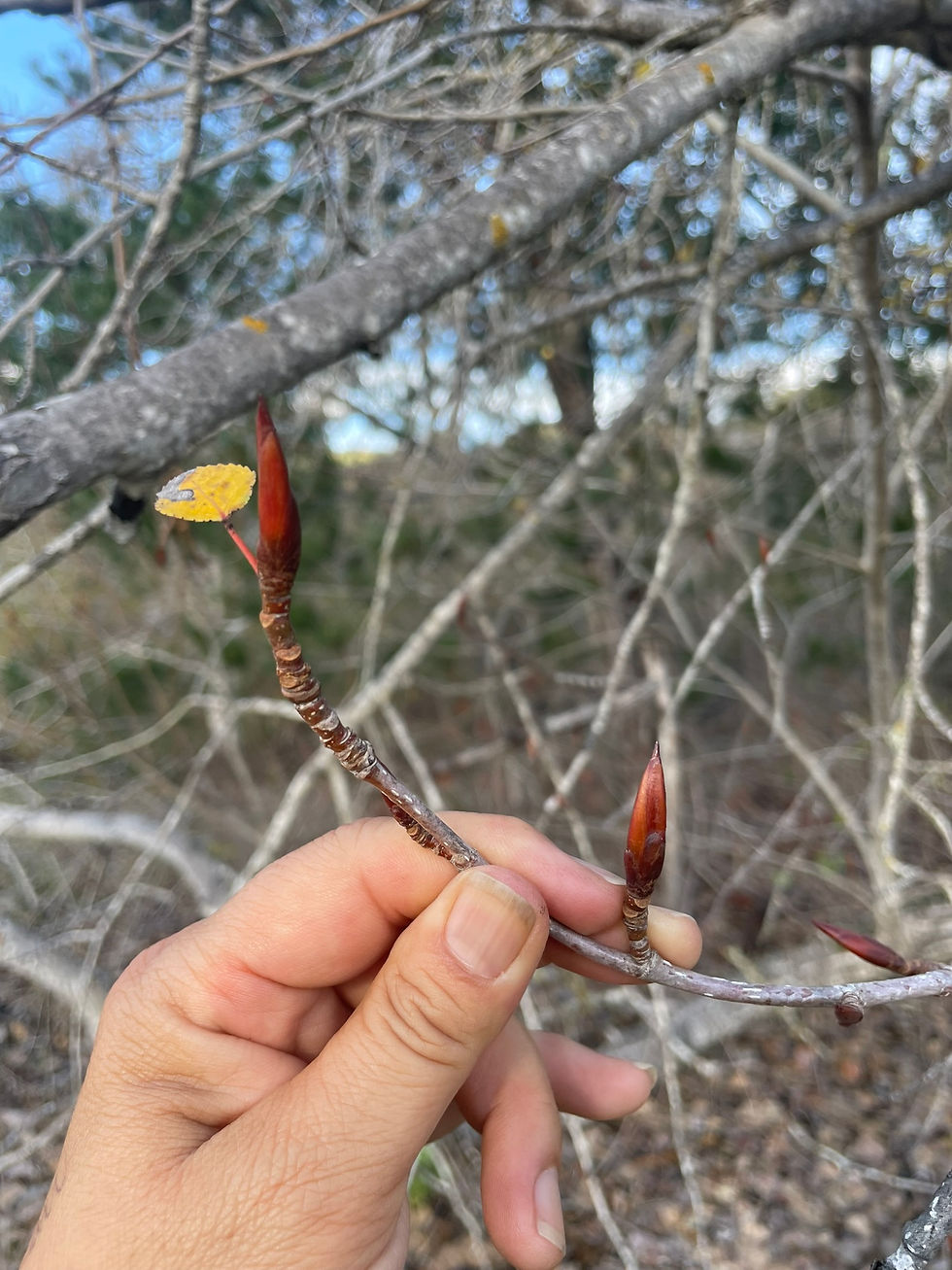
I can see how many limbs or trunks a tree has. Or if the color of the bark changes from root to crown.
Vacated nests from birds or squirrels stand out as a cluster of dried leaves in the bare branches. These clue remind us to return to these trees in the spring and summer for the residents who might return.
And its not just trees, but deciduous (shedding leaves in winter) shrubs reveal similar information.
Poison oak has a distinct look to its branches, so I can sort of tell them even without leaves.
Red osier dogwood has cranberry red, smooth alternate branches, while
Willow has golden branches studded with buds.
I use my nature journal to hold my observations and conversation notes as I get to know these trees- sketching bare branches, and notable markings, noticing the tips of branches and buds.
No two trees are alike
Now, not only is there a visual difference between species of trees (like oak versus maple versus walnut), but you can see the difference between individual trees too!
In a nearby forest, I gaze up and ancient Monterey pines. I see that each tree is unique and that I could tell them apart. Their history is told in the shape of the trunk, or density/sparseness of branches, missing limbs, scars from fire or animals, the leaning boughs, or branches that have been trimmed away.
In the decades or centuries they have been standing in this exact spot, they’ve experienced so much.
Each of these giant sequoias have variations in trunk and branch shapes.
There's more to Tree that just the structure
Trees aren't just part of the landscape, although most people don't notice them. The are integral living beings on our planet and we have an interconnected relationship with trees. Not only do we share breath with them- they need our CO2 (Carbon dioxide) from our exhale, but they provide O2 (Oxygen) for our inhales we need them for food, shelter, clothing, shade, weather and more....
Trees also are a mirror, a wise friend sharing wisdom through an unseen exchange. I like to visit a tree and quietly have a conversation with them, observing and tuning into what I notice about it. If I'm intentional with my time and connection, I can begin to see something that the tree is sharing that could be helpful in my life.
For example, my neighbor's willow tree, partially cut down, with a trunk that was about 6 feet tall. It had new branches sprouting out from the trunk like sparklers at several spots. As I sat, contemplated its growth and sketched it, I asked what wisdom it wanted to share with me.

These are the words that flowed to me.
You always have a choice- to wind your way through what appears to be roadblocks or wither where you stand. Even if the path is blocked or you feel cut off, find the way up and out through new directions. Set your intention to grow or settle. Always choose to burst forth and shine your light. You are an ecosystem and we await to see your unique color add to the sparkling starburst..a firework of you.
This came at a time where I was feeling stuck in my life, and feeling a bit hopeless. What willow shared with me was that SHE was choosing the path of growth always- because its what she does. And I can do it too.
Going slow with your journal
When we take the time to stop and take a closer look its possible to see so many things that we were never before aware of-- both visible and non-visible. And with your nature journal you practice expanding your awareness, a sense of fascination and wonder, and deepen your relationship with nature. And, it also brings a grounded sense of calm and replenishes your spirit.
If we pay close attention to its entire structure- its body- we can read the story of its life. Winter resting trees can tell us their stories if we only stop and give our attention.

Discover for yourself: go out to see trees
Now, I invite you to go out in nature– or look out the window.
Do you see leaf-less or deciduous trees?
Notice how the branches are shaped.
What direction do they grow? Are they upright or growing sideways?
And now, find another tree- either the same kind or a different species.
Do its branches look the same as the last?
Are there new buds forming?
Do you see any nests– or clusters of leaves concentrated in one spot?
What color is the bark and branches?
What is the shape of the tree crown? What does it remind you of?
What else do you notice?
Take some breaths and look again. Is there some wisdom in the tree that is being shared? There no right or wrong here- whatever you discern is good here.
Save these observations in your journal
Now jot those observations in your nature journal. Add the date. And maybe a sketch of one branch or a scribble sketch of the tree.
You have permission to focus on the tree and let go of perfect sketches or handwriting.
Now, there is no need to know its name right now. You can find that out later. For now, we are focusing on seeing the tree- all of the tree, and giving it mindful attention.
Later on, leaves give us more clues
After the leaves grow in, it will be easier to identify it, or at least narrow down to a family.
But for now, through your personal observations, you are getting to know this tree in a much deeper way -- one that you can’t learn from a book or website-- and you're cultivating a connection and appreciation.
Visit these trees again in spring or summer.
What kind of leaves emerge?
collect a leaf and trace it, and/or press it into your journal.
You can decide to follow this tree over the seasons, and get to know how it changes.
Because you are spending time in nature you are also benefiting from the calming and healing effects.
Take a dive into deepening your kinship with trees:
If you want to dive deeper into exploring trees, you can join Befriending Trees, a seasonal self-paced course that focuses on how to see trees each season in a new way, reading their stories and developing a meaningful connection. See the course here. for details.


Comments